
See more related videos: See more related video:Analysis of Variance (ANOVA)
|
See more related videos: See more related video:Analysis of Variance (ANOVA) |
|
|
The factorial ANOVA models consider a completely randomized design for an experiment.
Origin supports following factorial ANOVA models .
| Designs | Details |
|---|---|
| One-way | compares three or more levels within one factor. |
| Two-way | compare the effect of multiple levels of two factors, used to analyze the main effects of and interactions between two factors. |
| Three-way (Pro Only) | tests for interaction effects between three independent variables on a continuous dependent variable (i.e., if a three-way interaction exists) |
In addition to the analysis of variance, Origin also supports various methods for means comparison and actual and hypothetical power analysis.
The ANOVA model has the following assumptions:
The normality test and the Homogeneity Tests(Levene's Test) can be used to verify the assumptions. Please see Assumptions for more information.
Multiple comparison procedures are commonly used in an ANOVA after obtaining a significant omnibus test result. The significant ANOVA result suggests that the global null hypothesis, H0, is rejected. The H0 hypothesis states that the means are the same across the groups being compared. We can use multiple comparison to determine which means are different.
Origin provides eight different methods for means comparison. They are Tukey, Bonferroni, Dunn-Sidak, Fisher LSD, Scheffe, Holm-Bonferroni, and Holm-Sidak.
| Tukey | The Tukey method controls the overall Type I error. When Tukey is used, the overall confidence level is  with equal sample sizes, that is, the risk of a Type I error is exactly with equal sample sizes, that is, the risk of a Type I error is exactly  ; while for unequal sample sizes, the risk of a Type I error is less than ; while for unequal sample sizes, the risk of a Type I error is less than
|
|---|---|
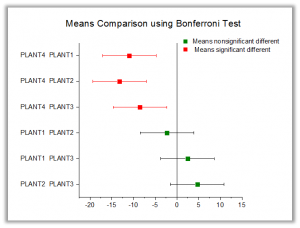
| Bonferroni | The Bonferroni method controls the overall Type I error and is more conservative than Tukey. The method is commonly used for all pairwise comparisons tests. |
| Fisher's LSD | Fishers LSD test dose not control the overall Type I error. Therefore, it should only be used for the significant overall F-test and the small number of comparisons. |
| Scheffé | When the number of comparisons is small, Scheffé is very conservative (and more than Bonferroni). Scheffé is more powerful in cases of complex multiple comparisons, so it is used for complex multiple comparisons. |
| Dunn-Sidak | This is a more powerful method than the Dunnett test method, especially when the number of comparisons is large. |
| Holm-Bonferroni | This method is less conservative and more powerful than the Bonferroni method. Hence you have more chances to reject null hypotheses with the Bonferroni-Holm method. |
| Holm-Sidak | The method is more powerful than Holm test. However, it can not be used to compute a set of confidence intervals. |
The power analysis procedure calculates the actual power for the sample data, which let you know the % chance of detecting a difference. It also helps you to calculate the hypothetical power if additional sample sizes are specified
The missing values in the data range will be excluded in the analysis
From Origin 2015, missing values in the grouping range and the corresponding data values will be excluded in analysis. In the previous version, missing values in the grouping range will be considered as a group.
| Features | Menu Entry |
|---|---|
| One-way | Statistics: ANOVA: One-Way ANOVA |
| Two-way | Statistics: ANOVA: Two-Way ANOVA |
| Three-way (Pro Only) | Statistics: ANOVA: Three-Way ANOVA |
|
Topics covered in this section:
|