2.2.1.9 xyz_shep_nag
Contents
Brief Information
Convert XYZ data to matrix using Modified Shepard gridding
Command Line Usage
1. xyz_shep_nag iz:=Col(3);
2. xyz_shep_nag iz:=Col(3) rows:=10 cols:=10;
4. xyz_shep_nag iz:=Col(3) q:=18 w:=9;
5. xyz_shep_nag iz:=Col(3) om:=[MBook]MSheet!Mat(1);
X-Function Execution Options
Please refer to the page for additional option switches when accessing the x-function from script
Variables
| Display Name |
Variable Name |
I/O and Type |
Default Value |
Description |
|---|---|---|---|---|
| Input | iz |
Input XYZRange |
|
Specifies the input XYZ range. |
| Rows | rows |
Input int |
|
Rows in the output matrix. |
| Columns | cols |
Input int |
|
Columns in the output matrix. |
| Quadratic | q |
Input int |
|
The quadratic interplant locality factor, which is used to calculate the influence radius of local approximate quadratic fitted function for each node. By default, q equals to 18. It is better to make q ≈ 2w and it should be satisfy that 0<w≤q. Modifying these factors could increase gridding accuracy, though note that the computation time can be greatly increased for large values (i.e. values that decrease the locality of the method.) |
| Weight | w |
Input int |
|
The weight function locality factor, which is used to calculate the weighting radius for each node. By default, w equals to 9. It is better to make q≈2w and it should be satisfy that 0<w<q. Modifying these factors could increase gridding accuracy, though note that the computation time can be greatly increased for large values (i.e. values that decrease the locality of the method.) |
| Output Matrix | om |
Output MatrixObject |
|
Specify the output matrix object. See the syntax here. |
Description
This function calls NAG library to perform modified Shepard gridding method which described by Franke and Nielson[1]. This is a distance-based method and improves the Shepard's method by some local strategies. During gridding, only the data points that lying within certain ranges, \(R_q\) and \(R_w\), to the grid nodes are considered. To make it easier for setting, two integers, \(N_q\) and \(N_w\) are used to calculate \(R_q\) and \(R_w\) (parameters q and w of the function, and called Quadratic Interplant Locality Factor and Weight Function Locality Factor, respectively). Increase the value of \(N_q\) and \(N_w\) will make the calculation more global, vice versa. Generally speaking, setting \(N_q \) ≈ \(2*N_w\) works fine and by default, Nq=18, Nw=9. However, the following constraints: 0< \(N_w\)≤\(N_q\) should be satisfied.
The value of \(R_q\) and \(R_w\) in this function is fixed and there is another similar X-Function xyz_shep which described by Renka[2] uses a vary \(R_q\) and \(R_w\) strategy.
Examples
1. Import XYZ Random Gaussian.dat on the \Samples\Matrix Conversion and Gridding folder.
2. Type xyz_shep_nag 3 in the command window. Or type xyz_shep_nag -d to bring up the dialog.
Algorithm
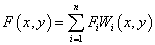
This is a distance-based weighted gridding method which interpolate data by:
 ,
,
where \(F_i\) is the underlying function at nodes (\(x_i\), \(y_i\)), and \(W_i(x, y)\) is the weights. To make the function more local, \(F_i\) and \(W_i\) are calculated only by the data points lying in the circle with center (\(x_i\), \(y_i\)) and some radius R..
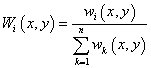
Firstly, the weights are defined as:
 .
.
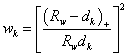
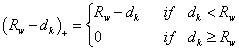
Given a radius \(R_w\), the relative weight \(w_k\) is:
 for
for
 ,
,
and \(d_k\) is the Euclidean distance between (x, y) and (\(x_k\), \(y_k\)):
 .
.
For any \(R_w\)>0, we have:
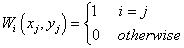
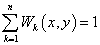 .
.
Secondly, the nodal function \(F_i\) is replaced by a local approximation function \(Q_k\):

\(Q_k\) is the weighted least-square quadratic fitted function to the data located within \(R_q\) of nodal points. So the coefficients minimize:

for
 .
.
It can be seen above that the interpolate function is a local approximation function and depends on the radius of influence about nodal points, \(R_q\) and \(R_w\). In this method, two integers \(N_q\) and \(N_w\) are used to calculate \(R_q\) and \(R_w\):
 and
and  ,
,
where n is the number of data points and D is the maximum distance between any pair of data points. So \(N_q\) and \(N_w\) can be considered to be the average numbers of data points lying within distance \(R_q\) and \(R_w\) respectively for each node.
References
[1]. Franke R and Nielson G. smooth Interpolation of Large Sets of Scattered Data. Internat. J.Num. Methods Engrg. 1980, 15, pp:1691-1704.
[2]. Renka, R. J., Multivariate Interpolation of Large Sets of Scattered Data. ACM Transactions on Mathematical Software, Vol. 14, No. 2, June 1988, pp:139-148.
Related X-Functions
xyz_regular, xyz_renka, xyz_renka_nag, xyz_shep, xyz_sparse, xyz_tps
Keywords:worksheet