2.2.1.8 xyz_shep
Contents
Brief Information
Convert XYZ data to matrix using Shepard gridding
Command Line Usage
1. xyz_shep iz:=Col(3);
2. xyz_shep iz:=Col(3) rows:=10 cols:=10;
3. xyz_shep iz:=Col(3) q:=13 w:=19;
4. xyz_shep iz:=Col(3) om:=[MBook]MSheet!Mat(1);
X-Function Execution Options
Please refer to the page for additional option switches when accessing the x-function from script
Variables
| Display Name |
Variable Name |
I/O and Type |
Default Value |
Description |
|---|---|---|---|---|
| Input | iz |
Input XYZRange |
|
Specifies the input XYZ range. |
| Rows | rows |
Input int |
|
Rows in the output matrix. |
| Columns | cols |
Input int |
|
Columns in the output matrix. |
| Quadratic | q |
Input int |
|
The quadratic interplant locality factor, which is used to calculate the influence radius of local approximate quadratic fitted function for each node. By default, q equals to 13. Modifying these factors could increase gridding accuracy, though note that the computation time can be greatly increased for large values (i.e. values that decrease the locality of the method.) |
| Weight | w |
Input int |
|
The weight function locality factor, which is used to calculate the weighting radius for each node. By default, w equals to 19. Modifying these factors could increase gridding accuracy, though note that the computation time can be greatly increased for large values (i.e. values that decrease the locality of the method.) |
| Output Matrix | om |
Output MatrixObject |
|
Specify the output matrix object. See the syntax here. |
Description
This function performs modified Shepard gridding method which described by Renka[1]. This is a distance-based method and improves the Shepard's method by some local strategies. During gridding, only the data points that lying within certain ranges, \(R_q\) and \(R_w\), to the grid nodes are considered. To make it easier for setting, two integers, \(N_q\) and \(N_w\) are used to calculate \(R_q\) and \(R_w\) (parameters q and w of the function, and called Quadratic Interplant Locality Factor and Weight Function Locality Factor, respectively). Increase the value of \(N_q\) and \(N_w\) will make the calculation more global, vice versa. Generally speaking, setting \(N_q\) and \(N_w\) works quite well.
The value of \(R_q\) and \(R_w\) in this function is varied for each node. There is another similar X-Function xyz_shep_nag which described by Franke and Nielson[2] uses a fixed \(R_q\) and \(R_w\) calculation.
Examples
- To run from Command window
- Import XYZ Random Gaussian.dat on the \Samples\Matrix Conversion and Gridding folder.
- Type
xyz_shep 3in the command window. Or typexyz_shep -dto bring up the dialog.
- Code Sample
/*
This example shows how convert random worksheet data into matrix by Shepard gridding method.
The sample data is exe_path\Samples\Matrix Conversion and Gridding\XYZ Random Gaussian.dat
1. Load data to a new created workbook.
2. Random xyz gridding by Shepard method.
3. Plot a contour graph.
*/
// Get sample data
fn$ = system.path.program$ + "Samples\Matrix Conversion and Gridding\XYZ Random Gaussian.dat";
newbook;
impASC fn$;
// Set the third column as Z column
wks.col3.type = 6;

// Convert worksheet data into matrix by Shepard gridding method
xyz_shep 3;

// Plot
worksheet -p 226 contour;
Algorithm
This is a distance-based weighted gridding method which interpolate data by:
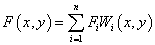 ,
,
where \(F_i\) is the underlying function at nodes (\(x_i\), \(y_i\)), and \(W_i\)(x, y) is the weights. To make the function more local, \(F_i\) and \(W_i\) are calculated only by the data points lying in the circle with center (\(x_i\), \(y_i\)) and some radius R..
Firstly, the weights are defined as:
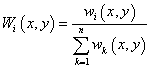 .
.
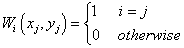
Given a radius (\(R_w\), the relative weight (\(w_k\) is:
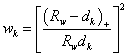 for
for
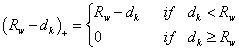 ,
,
and (\(d_k\) is the Euclidean distance between (x, y) and (\(x_k\), \(y_k\)):
 .
.
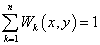
For any (\(R_w\) >0, we have:
 .
.
Secondly, the nodal function (\(F_i\) is replaced by a local approximation function \(Q_k\):

(\(Q_k\) is the weighted least-square quadratic fitted function to the data located within (\(R_q\) of nodal points. So the coefficients minimize:

for
 .
.
It can be seen above that the interpolate function is a local approximation function and depends on the radius of influence about nodal points, (\(R_q\) and (\(R_w\). In this method, (\(R_q\) and (\(R_w\) are varied for each nodal point to make the calculation more accurate. Given two integers (\(N_q\) and (\(N_w\), (\(R_q\) and (\(R_w\) are chosen just large enough to include (\(N_q\) and (\(N_w\) nodes.
References
[1]. Renka, R. J., Multivariate Interpolation of Large Sets of Scattered Data. ACM Transactions on Mathematical Software, Vol. 14, No. 2, June 1988, pp:139-148.
[2]. Franke R and Nielson G. smooth Interpolation of Large Sets of Scattered Data. Internat. J.Num. Methods Engrg. 1980, 15 pp:1691-1704.
Related X-Functions
xyz_regular, xyz_renka, xyz_renka_nag, xyz_shep_nag, xyz_sparse, xyz_tps
Keywords:worksheet