2.7.35 impFamos
Contents
Menu Information
Data: Import from File: Famos (DAT, RAW) imc2, imc3 format.
If you do not see this file type, choose Data: Import from File: Add/Remove File Types...
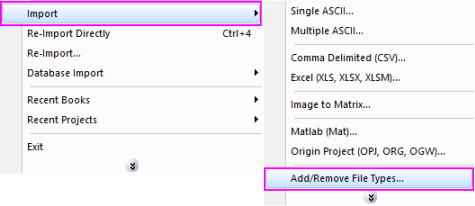
 | To add drag & drop support for a file type, see Import Filter Manager. |
Brief Information
Import Famos files
Command Line Usage
impFamos fname:="c:\test.dat";
X-Function Execution Options
Please refer to the page for additional option switches when accessing the x-function from script
Variables
| Display Name |
Variable Name |
I/O and Type |
Default Value |
Description |
|---|---|---|---|---|
| File Name | fname |
Input string |
|
Filename of the file to be imported. |
| File Info | trfiles |
Input TreeNode |
|
This is used in the dialog for displaying the basic information of the file.
|
| Import Options | options |
Input TreeNode |
|
This is used to tweak the import options in the dialog. Please see the Description part of this document for details.
|
| Output | orng |
Output Range |
|
This is used to specify the output range. See the syntax here. |
| Header Information | trheader |
Output TreeNode |
|
This is for outputting the header information. It is hidden from the GUI. Users are not advised to use this variable.
|
Description
This X-Function is used for importing Famos data files.
Details on Some Dialog Options
- Import Options(options)
- Please see this page for more details.
Examples
1. The following example imports a Famos data file into a new book and renames the book with the filename:
- a. From the Origin menu, select Data: Import from File: Famos (DAT, RAW). This opens the Famos File dialog for you to choose the import file.
- b. Browse to the folder where your data file is. Select the file and click the Add File(s) button. Click OK to close the dialog box.
- c. In the impFamos dialog box, expand Import Options. Select Start new books for Import Mode. Make sure that Rename book with (partial) filename is checked and Trim filename from and Trim filename to textboxes below it are 1 and 0, respectively. Click Ok to close the dialog.
2. The following script command imports a famos file (c:\test.dat) without opening the dialog:
- Fname$="c:\test.dat";
- impFamos;