5.5.16.2.5 Taguchi Design
Contents
Introduction
Taguchi Design is a robust experimental design methodology developed by Genichi Taguchi. Its primary goal is to create a robust product or process—one that performs consistently despite variations in environmental conditions (noise factors).
When to select
- Robustness to noise is the primary goal
- Many factors must be screened with limited runs
- Noise factors are identifiable and controllable during experimentation
- Manufacturing or production optimization context
- Standard orthogonal arrays fit the problem structure
- Main effects dominate; interactions are negligible
When not to select
- Factor interactions are critical or unknown
- Precise effect estimation and statistical modeling are required
- Noise factors are not identifiable or controllable
- Response mean and variance trade off in complex ways
Understanding and Configuring Taguchi Design Settings
See the Key Concepts of Taguchi Design page for guidance on configuring Taguchi design settings.
- Orthogonal Arrays
- Signal-to-Noise (S/N) Ratio
- Control vs. Noise Factors
- Static vs. Dynamic Designs
How to create the Design
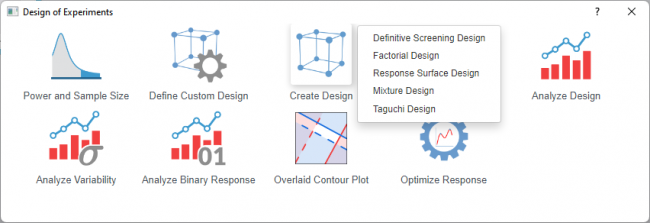
Create Taguchi Design
- Select Statistics: Quality Improvement: Design of Experiment from Origin menu
- Select the Create Design icon and choose Taguchi Design from the list
Create Custom Taguchi Design
Please refer to the define custom design page for instructions
|
Topics covered in this section: |