



|
|
|
Nonparametric tests are used when you don't know whether your data are normally distributed, or when you have confirmed that your data are not normally distributed.
This tutorial will show you:
Nonparametric tests do not require the assumption of normality. They are commonly used in the following situations:
| Nonparametric | Parametric | ||
|---|---|---|---|
| Data from any distribution | Data from normal distribution | ||
| Small Samples | Large Samples | ||
| One Sample | Wilcoxon Signed Rank Test | One Sample T-Test | |
| Two Samples | Independent Samples |
|
Two Sample T-Test |
| Paired Samples |
|
Paired Sample T-Test | |
| Multiple Samples | Independent Samples |
|
One Way ANOVA |
| Related Samples | Friedman ANOVA | One Way Repeated Measure ANOVA |
The One-Sample Wilcoxon Signed Rank test is designed to examine the population median relative to a specified value. You may choose a one- or two-tailed test. The Wilcoxon signed rank test hypotheses are
H0: median = hypothesized median versus H1: median ≠ hypothesized median.
In this example, a quality engineer in a production shop is interested in whether median (or average) of the weight of product is equal to 166. So select 10 product at random and measured their weight . The data measured as following:
151.5 152.4 153.2 156.3 179.1 180.2 160.5 180.8 149.2 188.0
The engineer perform Normality Test to determine if the distribution of the data is normal distribution


According to result,P-value=0.03814,the distribution of the data is not normal distribution at the 0.05 level. So, perform One-Sample Wilcoxon Signed Rank test:


According to the result, it fails to reject null hypothesis at the 0.05 level and concludes that the median is equal to 166.
Origin provides two tests for non-parametric statistics of two sample independent system: the Mann-Whitney Test and Two Sample Kolmogorov-Smirnov Test.
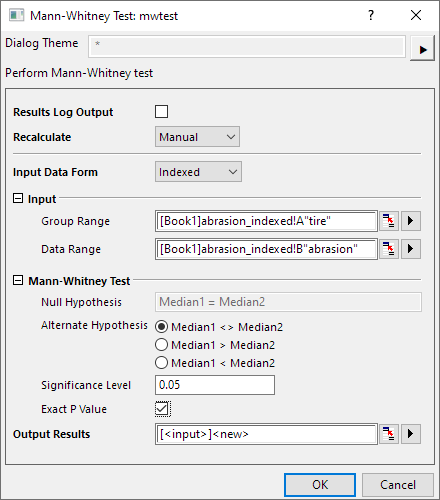
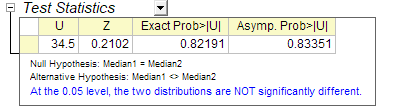
This following example shows the practical use of Mann-Whitney Test. The abrasions(in mg) are measured for two types of tires(A and B), 8 experiments were carried out for each tire type. The data is indexed and stored in abrasion_indexed.dat file.
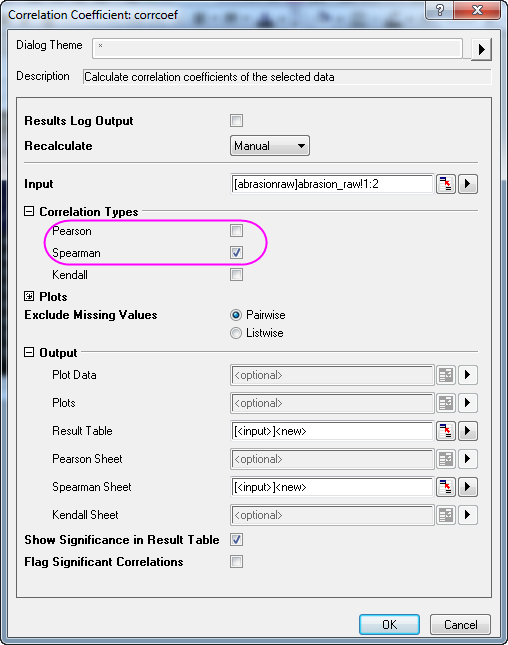
Correlation coefficient is used as a measure of relationship between two variables.It is possible to calculate the correlation coefficient for non-parametric statistics.
Origin provides two non-parametric methods to measure the correlations between variables:
The following example shows how to calculate correlation coefficient for non-parametric situations.
From the value of Spearman Corr., it can be concluded that the abrasion between tire A and tire B are strongly related.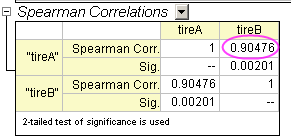
We will compare the two medians of tire A and tire B in above example.


We can conclude that two medians are significantly different. Obviously, median of group A is larger than that of group B.
In this example, the gas mileage of four car makers are measured. Several experiments are carried out for each car makers. The results are listed in the sample data table.
| GMC/mpg | Infinity/mpg | Saab/mpg | Kia/mpg |
|---|---|---|---|
| 26.1 | 32.2 | 24.5 | 28.4 |
| 28.4 | 34.3 | 23.5 | 34.2 |
| 24.3 | 29.5 | 26.4 | 29.5 |
| 26.2 | 35.6 | 27.1 | 32.2 |
| 27.8 | 32.5 | 29.9 | |
| 30.6 | 30.2 | ||
| 28.1 |
To evaluate whether the gas mileage of the four car makers are equal, and which one is the most efficient, Kruskal-Wallis ANOVA is chosen as the nonparametric test method.
 next to Input, and select All Columns in the context menu;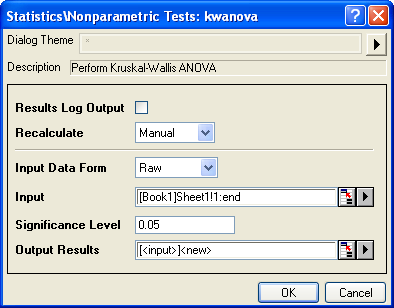
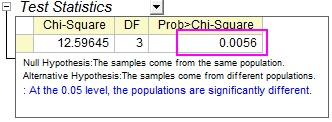
From the p-value we can conclude that gas mileage of the four car makers are significant different.
Ophthalmologists are investigating whether laser He-Ne therapy works for children. They have data from 2 groups, 6-10 Years Old and 11-16 Years Old. Each data set contains study of 5 persons' naked-eye eyesight difference after 3 period of therapy. The results are stored in the eyesight.dat.
Due to the small sample size, non-parametric statistics would be needed in analysis, following the steps below:
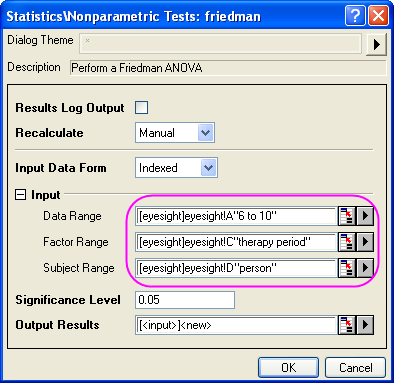
The p-value of  is 0.0067379, which is less than 0.05. The populations are significantly different, indicating that the therapy are effective for the age group 6-10.
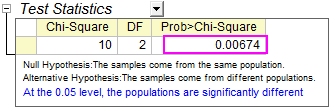
In a similar way, choose column B as Data Range and the rest setting of Input are the same with Step 3 previously.
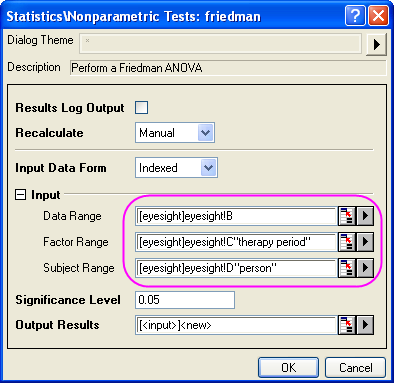
Check the result, we can see that p-value of  is 0.02599, less than 0.05 or 0.10. So we can also conclude that eyesight of 11-16 years old kids is better after 3 period of therapy.
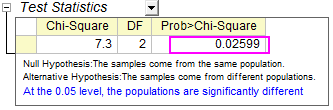
And we can see that >,that means, laser He-Ne therapy works better on 6-10 years old kids. The earlier children are to be involved in therapy, the more their eyesight can be improved.