



|
|
|
In this tutorial we will show you how to define an ordinary differential equation (ODE) in the Fitting function Builder dialog and perform a fit of the data using this fitting function.
Minimum Origin Version Required: Origin 9.1 SR0
This tutorial will show you how to:
In this tutorial, we will use a first order ordinary differential equation as an example:


where a is a parameter in the ordinary differential equation and y0 is the initial value for the ODE. NAG functions d02pvc and d02pcc are called using the Runge–Kutta method to solve the ODE problem.
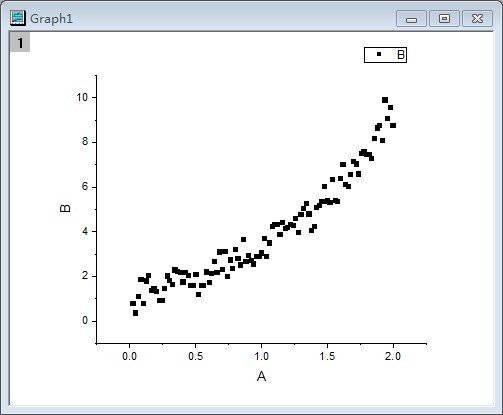
The fitting function can be defined using the Fitting Function Builder tool.
 button on the right of the Function Body edit box and define the function in Code Builder as follows.
Include header files for NAG and fitting:
button on the right of the Function Body edit box and define the function in Code Builder as follows.
Include header files for NAG and fitting:
#include <oc_nag.h>
#include <ONLSF.H>
Define a static function to solve ODE by calling NAG functions. Call NAG function d02pvc to establish ODE model and d02pcc to solve the model:
struct user   // parameter in the ODE
{
	double a;
};

//Define the differentiate equation: y'=a*y
static void NAG_CALL f(double t, Integer neq, const double *y, double *yp, Nag_Comm *comm)
{
	neq; //Number of ordinary differential equations
	t; //Independent variable
	y; //Dependent variables
	yp; //First derivative

	struct user *sp = (struct user *)(comm->p);
	double a;
	a = sp->a;

	yp[0] = a*y[0];
}


//Use Runge-Kutta ODE23 to solve ODE
static bool nag_ode_fit( const double a, const double y0, const double tstart,
  const double tend, const int nout, vector &vP )
{
	//nout: Number of points to output
	if( nout < 2 )
		return false;

	vP.SetSize( nout );
	vP[0] = y0;

	int neq = 1; //Number of ordinary differential equations
	Nag_RK_method method;

	double hstart, tgot, tinc;

	double tol, twant;
	int i, j;

	vector thres(neq), ygot(neq), ymax(neq), ypgot(neq), ystart(neq);

	Nag_ErrorAssess errass;
	Nag_Comm comm;

	struct user s;
	s.a = a;
	comm.p = (Pointer)&s;
	ystart[0] = y0;
	for (i=0; i<neq; i++)
		thres[i] = 1.0e-8;
	errass = Nag_ErrorAssess_off;
	hstart = 0;
	method = Nag_RK_2_3;
	tinc = (tend-tstart)/(nout-1);
	tol = 1.0e-3;

	NagError nagErr1;
	//Setup ODE
	int iwsav[130];
	double* rwsav = (double*)malloc((350 + 32*neq)*sizeof(double));
	nag_ode_ivp_rkts_setup(neq, tstart, tend, ystart, tol, thres, method, errass, hstart, iwsav, rwsav, &nagErr1);

	if( nagErr1.code != NE_NOERROR )
	{
		free(rwsav);
		return false;
	}

	for (j=1; j<nout; j++)
	{
		twant = tstart + j*tinc;
		NagError nagErr2;
		//Solve ODE
		nag_ode_ivp_rkts_range(f, neq, twant, &tgot, ygot, ypgot, ymax, &comm, iwsav, rwsav, &nagErr2);

		if( nagErr2.code != NE_NOERROR )
		{
			free(rwsav);
			return false;
		}

		vP[j] = ygot[0];
	}

	free(rwsav);
	return true;
}
Define the fitting function body _nlsfFitODE:
NLFitContext *pCtxt = Project.GetNLFitContext();
if ( pCtxt )
{
  static vector vX, vY;
  static int nSize;

  BOOL bIsNewParamValues = pCtxt->IsNewParamValues();
  // If parameters were updated, we will recalculate the ODE result.
  if ( bIsNewParamValues )
  {
    //Initial and final values of the independent variable
    double tstart = 0.02, tend = 2, tinc;
    int nout = 100; //Number of points

    tinc = (tend-tstart)/(nout-1);
    vX.Data( tstart, tend, tinc );
    nSize = vX.GetSize();

    if( !nag_ode_fit( a, y0, tstart, tend, nout, vY) )
      return;
  }

  //Interpolate y from fitting data's x on the ODE result.
  ocmath_interpolate( &x, &y, 1, vX, vY, nSize );
}
Click the Compile button to compile the function body. To return, click Return to Dialog button. The Evaluate button on the dialog has a black figure of a running person. Clicking on it will show y=2.6627270424371. This implies that the function works. Click Next.
//Set the start y value in fitting data as the initial value of y0
y0 = y_data[0];
a = 1;
and click Finish.
| Note: In order to monitor the the fitted parameters, NLFitContext class was introduced in defining fitting function to achieve some key information within the fitter |

The fitted curve should resemble the following image:
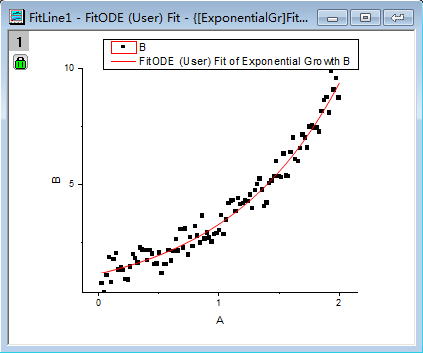
Fitted Parameters will be shown as in the following table:
| Parameter | Value | Standard Error |
|---|---|---|
| a | 1.30272 | 0.00858 |
| y0 | 0.77038 | 0 |
Note: Fitting with more complex ODE fitting functions can also be done in a similar way.