


For Two-Way Repeated Measures ANOVA, "Two-way" means that there are two factors in the experiment, for example, different treatments and different conditions. "Repeated-measures" means that the same subject received more than one treatment and/or more than one condition. Similar to two-way ANOVA, two-way repeated measures ANOVA can be employed to test for significant differences between the factor level means within a factor and for interactions between factors. Using a standard ANOVA in this case is not appropriate because it fails to model the correlation between the repeated measures, and the data violates the ANOVA assumption of independence. Two-Way Repeated Measures ANOVA designs can be two repeated measures factors, or one repeated measures factor and one non-repeated factor. If any repeated factor is present, then the repeated measures ANOVA should be used.
In the following example, the two factors are the repeated measures factors.
Minimum Origin Version Required: Origin 8.6 Pro SR0
This tutorial will show you how to:
Origin can perform Two Way Repeated Measures ANOVA in both indexed and raw data modes. For Two-Way repeated measures ANOVA, if the indexed mode is used, data should be organized into four columns: Factor A, Factor B, Data, and Subject. When the Raw data mode is used, the different factors and levels should be in different columns.
In this example, we are interested in whether different drugs and doses have different effects on subject. We will perform the Two-Way Repeated Measures ANOVA to determined whether the drug type and dosage have significant effect on a subject. If there is significant difference, we will perform pairwise comparison to determine of which level the effects are different.
| Notes: Factor A and Factor B are set as repeated measures factor by default (The Repeat check box under Factor is checked ). If one factor is a non-repeated measures factor, just uncheck the Repeated check box. |
Go to the worksheet ANOVATwoWayRM1, where the analysis results are listed.
You can refer to this help file for details of interpreting results of repeated measures ANOVA.
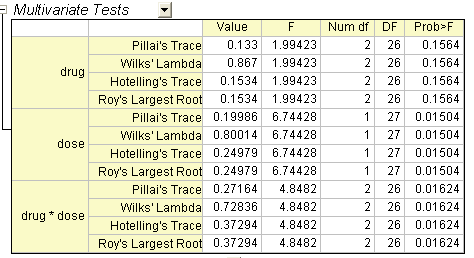
Origin uses a multivariate analysis to detect repeated-measures effects. In this example, four different methods (Pillai's trace, Wilks' lambda, Hotelling's trace, and Roy's largest root) generate identical F statistics and probabilities. For drugs, P_value=0.1564, so we can conclude that the effect of drugs did not reach conventional levels of statistical significance. Similarly, we can also conclude that dose and drugs* dose are significant.

This table shows the results of Mauchly's Test of Sphericity and evaluation of epsilon. From the column Prob>ChiSq, we can learn that the significance level of drugs is greater than 0.05 (P_value=0.11096), and the value of drugs*dose is smaller than 0.05. For drugs*dose, the assumption of sphericity has been violated. Note that Greenhouse-Geisser Epilon=0.65362, which is smaller than 0.75, so we will proceed with the test by using Greenhouse-Geisser correction.
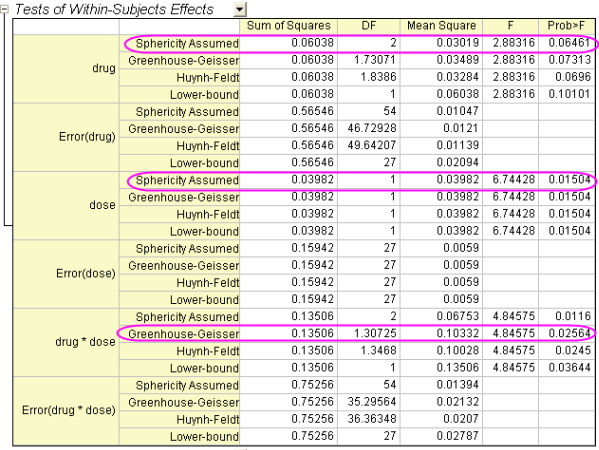
From this table we are able to find out the F value for the factor, its associated significance level and the effect size. For drug, the P_value is 0.06461 in the prob>F column, so drugs have no significant effect on subjects, while dose have(P_value=0.01504). For interaction drugs*dose, we can still proceed with the test by using the Greenhouse-Geisser correction and conclude that interaction drugs*dose have significant effect (P_value = 0.02564).
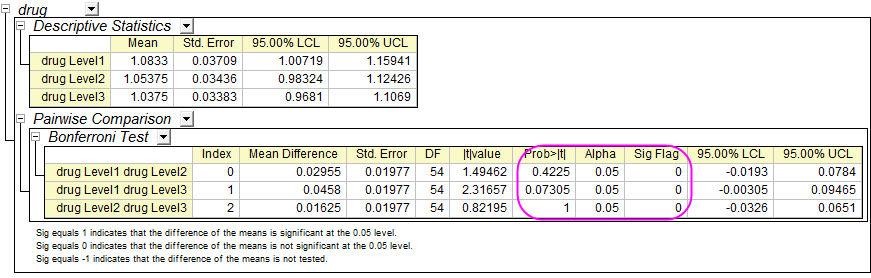
In general, Bonferroni tests are recommended to determine which specific means differed and determine whether or not the Sphericity assumption is violated. The Bonferroni correction relies on a general probability inequality and therefore isn't dependent on specific ANOVA assumptions. This table presents the results of the Bonferroni test, we can conclude that the means are not significant different (P>0.05 and Sig Flag=0). Of course, we do not need to perform pairwise comparison because drugs have no significant effect.
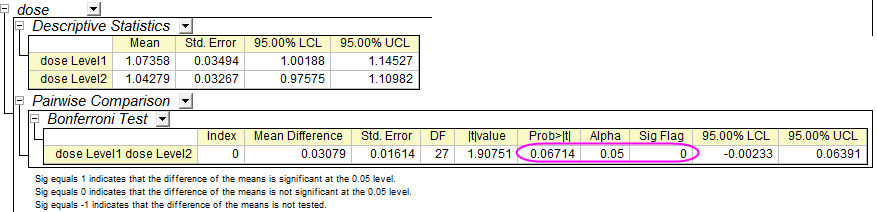
In this table, we can conclude that means of different dose are not significantly different (P_value = 0.06714 and Sig Flag = 0).
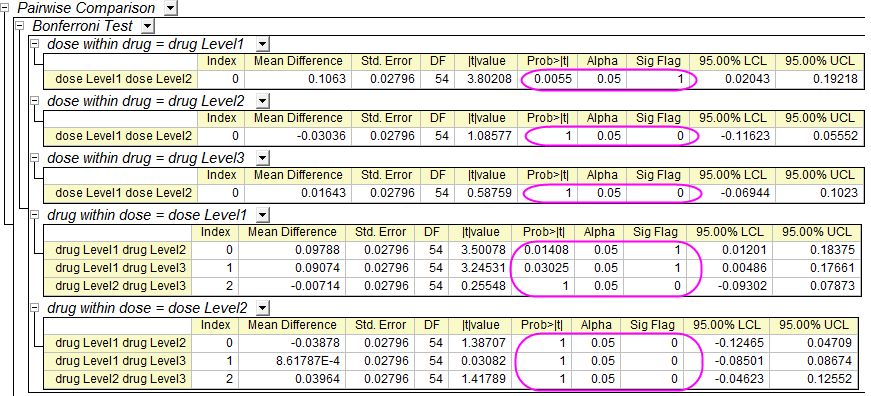
In this table, we can conclude that dose1 is significantly larger than dose2 within drug1, and drug1 is significantly larger than drug2 and drug3 within dose1.