17.6.2 Cox Proportional Hazard Regression
Contents
Introduction
In survival analysis, the proportional hazard model, also called the Cox model, is a classical semi-parameter method. It relates the time to an event, usually death or failure, to a number of explanatory variables known as covariates. Some of the observations are right-censored, that is the exact time to failure is not known, only that it is greater than a known time.
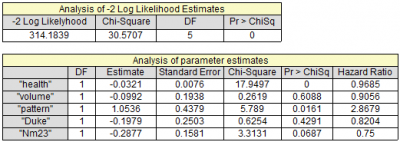
Following a CoxPHM Analysis, we obtain the parameter estimates and other statistics that are associated with the Cox Proportional hazards model for fixed covariates. From the result of Cox analysis, you can forecast changes in the hazard rate along with a variety of fixed covariates.
Handling Missing Values
If there are missing values in the Time/Censor/Covariate range, the whole case will be excluded in the analysis
Performing Cox Proportional Hazard Regression
To compute the Cox Proportional Hazards regression:
- Select Statistics: Survival Analysis: Cox Model Estimator. This opens the phm_Cox dialog box.
- Specify the Input Data, including the Time Range, the Censor Range and the Covariate Range. You can also specify several summary data tables, including one for event and censor values and a covariance and/or correlation matrix.
- Upon clicking OK, an analysis report sheet is generated that includes the desired tables.
Reference
|
Topics covered in this section: |