PsdVoigt1
Contents |
Function
![y=y_0+A\left[ m_u\frac 2\pi \frac w{4\left( x-x_c\right) ^2+w^2}+\left( 1-m_u\right) \frac{\sqrt{4\ln 2}}{\sqrt{\pi}w}e^{-\frac{4\ln 2}{w^2}\left( x-x_c\right) ^2}\right]](/origin-help/de/images/PsdVoigt1/math-b15a9bdac19e7c5a86407478c56fb945.png "y=y_0+A\left[ m_u\frac 2\pi \frac w{4\left( x-x_c\right) ^2+w^2}+\left( 1-m_u\right) \frac{\sqrt{4\ln 2}}{\sqrt{\pi}w}e^{-\frac{4\ln 2}{w^2}\left( x-x_c\right) ^2}\right]")
Brief Description
While Vogit peak function is the convolution of a Gaussian curve G(x) and a Lorentzian curve L(x), the Pseudo-Voigt peak function is an approximation of the Voigt peak function which instead using a linear-combination of Gaussian curve G(x) and a Lorentzian curve L(x).
Origin provides two types of Pseudo-Vogit peak functions: PsdVogit1 and PsdVogit2. When using PsdVogit1, you can only specify one FWHM value denoted as w which will be shared between Gaussian curve G(x) and a Lorentzian curve L(x); while with PsdVogit2, you can specify two distinct FWHM values wG for Gaussian curve G(x) and wL for Lorentzian curve L(x).
Sample Curve
Parameters
Number: 5
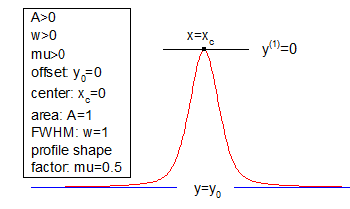
Names: y0, xc, A, w, mu
Meanings: y0 = offset, xc = center, A = area, w = FWHM, mu = profile shape factor
Lower Bounds: w > 0.0
Upper Bounds: none
Script Access
nlf_psdvoigt1(x,y0,xc,A,w,mu)
Function File
FITFUNC\PSDVGT1.FDF
Category
Spectroscopy