 , the inverse matrix
  (aka the reciprocal matrix), will satisfy the relationship:
The minverse X-Function generates an inverse matrix by dividing the adjoint by its determinant. When matrices do not have inverses or determinants, a Moore-Penrose pseudoinverse is computed.
For user-interface access to this function:
| Recalculate |
Controls recalculation of analysis results
For more information, see: Recalculating Analysis Results |
|---|---|
| Input Matrix |
Choose input matrix. For help with range controls, see: Specifying Your Input Data |
| Output Matrix |
Choose where to output the inverse matrix. For help with the range controls, see: Output Results |
For a square matrix of full rank, the inverse matrix (aka the reciprocal matrix), will satisfy the relationship:

where  is the identity matrix.
The calculation of can be expressed as:

where  is the determinant of matrix and
  is the adjoint.
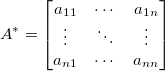

where  is the
  matrix by elimination of the
  column and
  row of .
When matrices do not have inverses or determinants, a Moore-Penrose pseudoinverse will be computed. It exists for any  matrix.
Given an  matrix ,
  is the unique
  pseudoinverse matrix. If
  and A has full rank, then the satisfies the following:

The computation is based on singular value decomposition (SVD) of the matrix and any singular values within tolerance, are treated as zero. If the rank of is not full, then the matrix will shrink to a smaller matrix.