18.12.1.2 Algorithms (Continuous Wavelet Transform)
Continuous Wavelet Transform
This function computes the real continuous wavelet coefficient for each given scale presented in the Scale vector and each position b from 1 to n, where n is the size of the input signal.
Let x(t) be the input signal and ψ be the chosen wavelet function, the continuous wavelet coefficient of x(t) at scale a and position b is:
\[C_{a,b} = \int_R {x(t)\frac{1}{{\sqrt a }}\psi^* } (\frac{{t - b}}{a})dt\]
The computation is implemented with a NAG function: nag_cwt_real(). It does not compute the coefficients with the definition of CWT. Instead, the integrals of the scaled, shifted wavelet function are approximated and the convolution is then computed.
Origin Wavelet Types
- Morlet
- The Morlet wavelet:
- \[\psi (x) = \pi ^{ - 1/4} \cos (kx)e^{ - x^2 /2}\]
- where k is the wave number.
- DGauss
- The Derivative of a Gaussian wavelet, which is the pth derivative of the Gaussian function:
- \[\psi (x) = (\frac{2}{\pi })^{ - 1/4} e^{ - x^2 }\]
- where p is the derivative order.
- MexHat
- The Mexican Hat Wavelet:
- \[\psi (x) = \frac{2}{{\sqrt 3 }}\pi ^{ - 1/4} (1 - x^2 )e^{ - x^2 /2} \]
Convert Scale to Pseudo Frequency
For a given wavelet, you can map a scale and convert to pseudo-frequency by ways below:
\[F_a=\frac{F_c}{s\cdot \Delta }\]
In this formula:
- s is a scale.
- \(\Delta\) is the sampling period.
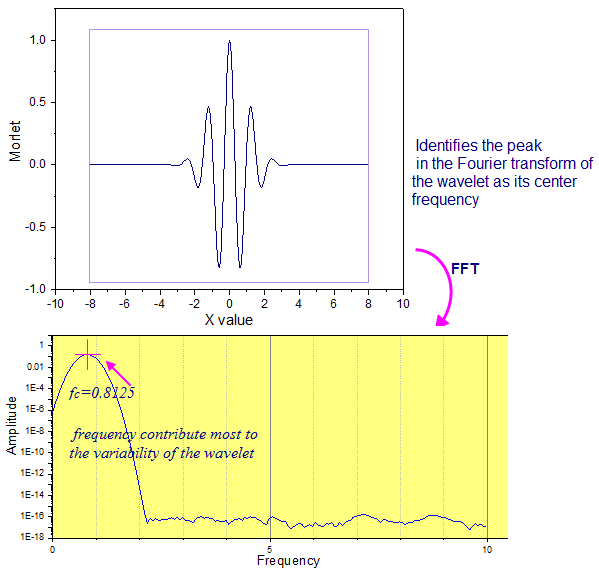
- \(F_c\) is the center frequency of a wavelet in Hz.
- \(F_a\) is the pseudo-frequency corresponding to the scale a, in Hz.
The \(F_c\) is the frequency contributes most to the variability of the wavelet, and it can be derived from maximizing the FFT of the wavelet modulus.