2.2.4.4.2 Algorithm for Winter's Method
NAG function nag_tsa_exp_smooth (g13amc) is used to smooth with Winter's method[1].
Winter's Method Model
- Multiplicative:





- Additive:




- where
 is the level(mean),
  is the trend and
  is the seasonal component at time
  with
with  being the seasonal order. The parameters,
  ,
,  and
and  control the weight of smoothing.
  ,
,  and
and  are data value, fitted value and smoothed value at time .
Initialization Method
- Intercept Difference between Groups
- Linear regression is carried out with the series as the dependent variable and the sequence 1,2,...,k as the independent variable. A separate intercept is used for each of the p seasonal groupings. The shared slope gives an estimate for
 and the mean of the intercepts is used as the estimate of
  .
.
- The seasonal parameters
 , for
, for  , are estimated as the intercepts
  .
.
- Averaging First Period[2]
- The level is the average of the first period. The slope is set to be the average of the slopes for each period in the first two period.

![T_0 = [(y_{p+1} + y_{p+2} + ... + y_{p+p}) - (y_{1} + y_{2} + ... + y_{p})] / p^2](/app/en/images/Algorithm_Winters/math-d4a70d5ac73c342b2292a3b143376ce4.png?v=0 "T_0 = [(y_{p+1} + y_{p+2} + ... + y_{p+p}) - (y_{1} + y_{2} + ... + y_{p})] / p^2")
- The initial seasonal values
 are calculated with
  for multiplicative seasonality, and
  for additive seasonality.
- Fitting Detrended Data
- Multiplicative: Add data with
 . Fit a regression with linear trend to the first period of data (if is less than 4, at least first 4 points are used). The initial is set to the regression slope. The initial level is set to the intercept subtracted by .
- Additive: Fit a regression with linear trend to the first period of data (if is less than 4, at least first 4 points are used). Then the initial level is set to the intercept, and the initial is set to the regression slope.
- The initial seasonal values are computed from the detrended data. Fit a regression with linear trend to the whole time series. The detrended data is calculated by subtracting (additive model) or dividing (multiplicative model) the trend. Perform a multiple linear regresstion to the detrended data with indicator variables. The coefficients of the regression model are used as the initial values for the seasonal indices.
Forecast
- Multiplicative:


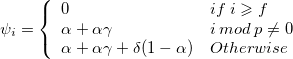
- where
 is estimated as the mean deviation.
- Additive:

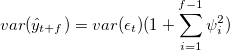
- where is estimated as the mean deviation.
Reference
- nag_tsa_exp_smooth (g13amc)
- Wongoutong, Chantha. (2021). Improvement of the Holt-Winters Multiplicative Method with a New Initial Value Settings Method.