2.5.4.2 Algorithm: Accelerated Life Testing
This tool supports two types of input.
Uncensor/Right Censor data:
The data are represented as time and censoring indicator pairs  :
:
-
 : The observed time for each unit. This could be Exact failure time (if the unit failed) or Time to censoring (if the unit did not fail within the observation period)
 -
 : Indicates whether the unitis a failure or censored. e.g. 1 = failure (uncensored), 0 = censored
-
Uncensor/Arbitrary Censor data:
The data are represented as time intervals  :
:
-
 : lower bound (time of last inspection or last known survival)
 -
 : upper bound (time when failure was first detected)
 - If
 , it represents right-censoring.
 - If
 , it represents exact failure (uncensored).
-
Regression Table
The lifetime regression function can be derived from the inverse cumulative distribution function. For weibull distribution:

-
 : time to failure
 -
 : cumulative probability
-
 : scale parameter (characteristic life)
 -
 : shape parameter
In Accelerated Life Testing, the logarithm of scale ( ) is linearly correlated to the transformed accelerating variable (
 ). We can then write the inverse cumulative distribution function as follows:

where
-
 .
. -
 : the transformed .
- Linear:

- Arrhenius:
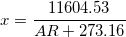
- Inverse temp:
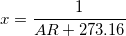
- Ln (Power):

-
 : coefficient of .
 -
 : intercept
 -
 : for weibull distribution, it is
  .
. -
 : the pth quantile of the standardized ditribution. For weibull distribution, it is
MLE (maximum likelihood estimation) method is then used to estimate parameters , and . For MLE, the standard error of the fitting parameters can be calculated by Fisher information matrix (FIM).
Probability Plot
Uncensor/Right Censor data
- Points on the plot is calculated by the Benard's method.
Uncensor/Arbitrary Censor data
- Points on the plot is calculated by the Turbull estimation[1]. Turnbull developed an iterative algorithm to obtain the nonparametric maximum likelihood estimate (NPMLE) of the cumulative distribution function for censored data. This approach is applicable to more general cases, including situations where the observation intervals overlap.
Reference
- B.W. Turnbull (1976). "The Empirical Distribution Function with Arbitrarily Grouped, Censored and Truncated Data". Journal of the Royal Statistical Society, 38: pp. 290-295.