2.17 Probability Distribution Calculator (Pro)
Contents
- 1 Summary
- 2 Examples
- 3 Dialog Settings
- 4 Formulas
- 4.1 Normal distribution
- 4.2 Lognormal distribution
- 4.3 t distribution
- 4.4 F distribution
- 4.5 Chi-squared distribution
- 4.6 Hypergeometric distribution
- 4.7 Geometric distribution
- 4.8 Beta distribution
- 4.9 Exponential distribution
- 4.10 Gamma distribution
- 4.11 Weibull distribution
- 4.12 Uniform distribution
- 4.13 Binomial distribution
- 4.14 Poisson distribution
- 4.15 Smallest Extreme Value distribution
- 4.16 Largest Extreme Value distribution
- 4.17 Logistic distribution
- 4.18 Log-logistic distribution
- 4.19 Folded Normal distribution
- 4.20 Rayleigh distribution
- 4.21 Gaussian Mixture distribution
Summary
The tool Critical Value of Distributions is used to calculate critical values of common distributions, such as Normal, LogNormal, t, F, Chi-squared, Hypergeometric, Geometric, Beta, Exponential, Gamma, Weibull, Uniform, Binomial and Poisson. The critical values can be (1) probability density, (2) cumulative probability, and (3) values of inverse cumulative probabliity.
Examples
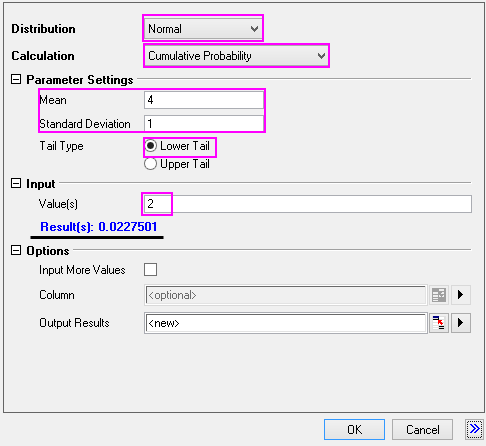
We want to calculate cumulative probability of Normal distribution at \(x=2\) with parameters mean = 4 and standard deviation = 1.
- This is a build-in App with Origin. If you haven't this tool, you can search the Probability Distribution Calculator in App Center to install it.
- Select Statistics: Descriptive Statistics: Probability Distribution Calculator or click the Probability Distribution Calculator app icon in App Galler to open the app dialog
- Choose Normal for the Distribution;
- Choose Cumulative Probability for the Calculation;
- In the part of Parameter Settings: let Mean = 4 and Standard Deviation=1, and then choose Lower Tail for the Tail Type;
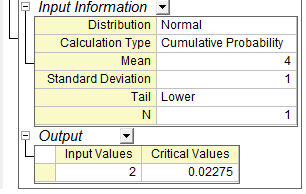
- In the part of Input: type 2. And we get the result is 0.0227501 below.
- Click OK to get the report table.
Dialog Settings
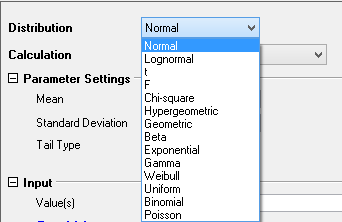
Distribution
Specify which distribution to concern. Normal, LogNormal, t, F, Chi-squared, Hypergeometric, Geometric, Beta, Exponential, Gamma, Weibull, Uniform, Binomial and Poisson distributions are available now.
Calculation
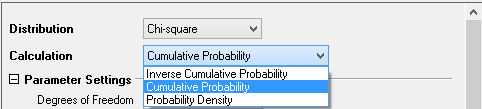
Specify which type of critical values to calculate.
- For continuous probability distributions such as Normal, LogNormal, t, F, Chi-squared, Beta, Exponential, Gamma, Weibull and Uniform, the values of probability density, cumulative probability, and inverse cumulative probability can be calculated.
- For discrete probability distributions such as Hypergeometric, Geometric, Binomial and Poisson, the values of probability density and cumulative probability can be calculated.
Parameter Settings
Set the values of parameters for the specific distribution chosen already.
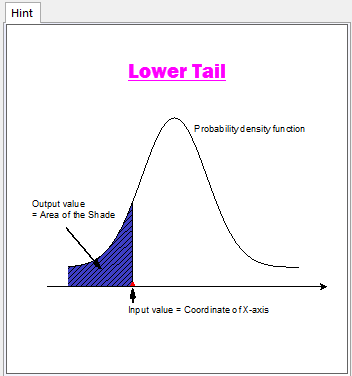
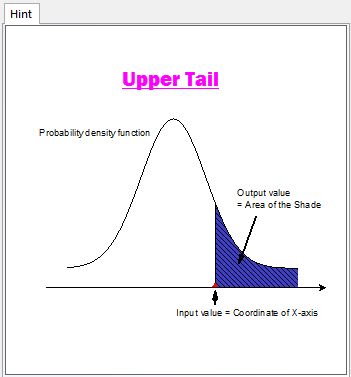
For Cumulative Probability and Inverse Cumulative Probability settings, Tail Type option is available to specify which tail type to calculate. The meaning of Lower Tail and Upper Tail is obvious by seeing the figure in the Preview window right to the setting dialog.
Input
Specify values at which the critical values of distribution are calculated. Several values can be input at the same time, separating by a space.

Options
Input more values from Worksheet and output the results.

Formulas
Normal distribution
The Normal distribution is also called Gaussian distribution. The probability density function is
\[f(x)=\frac{1}{\sqrt{2\pi}\sigma}e^{-\frac{(x-\mu)^2}{2\sigma^2}},\]
where \(\mu\) is the mean parameter; \(\sigma>0\) is standard deviation parameter; and \(-\infty < x < \infty\).
Lognormal distribution
The probability density function is
\[f(x)=\frac{1}{\sqrt{2\pi}\sigma(x-\theta)}e^{-\frac{(\ln(x-\theta)-\mu)^2}{2\sigma^2}},\]
where \(\mu\) is the scale parameter; \(\sigma>0\) is location parameter; \(\theta\) is threshold parameter; and \(x > \theta\).
t distribution
The probability density function is
\[f(x)=\frac{\Gamma[(v+1)/2]}{\Gamma(v/2)\sqrt{\pi v}}\left(1+\frac{x^2}{v}\right)^{-(v+1)/2},\]
where \(v\) is degree of freedom; and \(-\infty < x < \infty\). \(\Gamma\) is the Gamma function.
F distribution
The probability density function is
\[f(x)=\frac{\Gamma[(v+u)/2]}{\Gamma(v/2)\Gamma(u/2)} \left(\frac{u}{v}\right)^{u/2} x^{\frac{u}{2}-1} \left(1+\frac{u}{v}x\right)^{-(v+u)/2},\]
where \(u>0\) is numerator degree of freedom; \(v>0\) is denominator degree of freedom; and \(x>0\).
Chi-squared distribution
The probability density function is
\[f(x)=\frac{x^{(v-2)/2}e^{-x/2}}{2^{v/2}\Gamma(v/2)},\]
where \(v>0\) is degree of freedom; and \(x>0\).
Hypergeometric distribution
The probability density function is
\[f(x)=\frac{\binom{N_1}{x}\binom{N_2}{n-x}}{\binom{N}{n}},\]
where \(N = N_1+N_2\) is population size; \(N_1\) is number of events in the population; \(N_2\) is number of nonevents in the population; \(n\) is sample size; and \(x\) is number of events in the sample, s.t. \(\max\{0,n-N_2\}<x<\min\{n,N_1\}\).
Geometric distribution
If the domain is \(\{1,2,3,\cdots\}\), then the probability density function is
\[f(x)=p(1-p)^{x-1},\]
where \(p\) is event probability; and \(x\in \{1,2,3,\cdots\}\) is the total number of trials.
If the domain is \(\{0,1,2,3,\cdots\}\), then the probability density function is
\[f(x)=p(1-p)^{x},\]
where \(p\) is event probability; and \(x\in \{0,1,2,3,\cdots\}\) is the total number of nonevents occured before the first event is observed.
Beta distribution
The probability density function is
\[f(x)=\frac{\Gamma[\alpha+\beta]}{\Gamma(\alpha)\Gamma(\beta)} x^{\alpha-1}(1-x)^{\beta-1},\]
where \(\alpha>0\) is first shape parameter; \(\beta>0\) is second shape parameter; and \(0 \leq x \leq 1 \).
Exponential distribution
The probability density function is
\[f(x)=\frac{1}{\mu}e^{-(x-\theta)/\mu},\]
where \(\mu>0\) is scale parameter; \(\theta\) is threshold parameter; and \(x >\theta \).
Gamma distribution
The probability density function is
\[f(x)=\frac{(x-\theta)^{\alpha-1}}{\Gamma(a)b^a} e^{-(x-\theta)/b},\]
where \(a>0\) is shape parameter; \(b>0\) is scale parameter; \(\theta\) is threshold parameter; and \(x >\theta \).
Weibull distribution
The probability density function is
\[f(x)=\frac{\beta (x-\theta)^{\beta-1}}{\alpha^\beta} e^{-\left(\frac{x-\theta}{\alpha}\right)^\beta},\]
where \(\alpha>0\) is scale parameter; \(\beta>0\) is shape parameter; \(\theta\) is threshold parameter; and \(x >\theta \).
Uniform distribution
The probability density function is
\[f(x)=\frac{1}{b-a},\]
where \(a\) is lower endpoint; \(b\) is upper endpoint; and \(a\leq x \leq b \).
Binomial distribution
The probability density function is
\[f(x)=\binom{n}{x}p^x(1-p)^{n-x},\]
where \(n\) is number of trials; \(p\) is event probability; and \(x \in \{0,1,2,\cdots,n\} \).
Poisson distribution
The probability density function is
\[f(x)=\frac{\theta^x}{x!}e^{-\theta},\]
where \(\theta>0\) is mean; and \(x \in \{0,1,2,\cdots\} \). link title
Smallest Extreme Value distribution
The probability density function is
\[ f(x) = \frac{1}{\beta } e^{ \frac{x- \alpha}{\beta}} e^{ - e^{ \frac{x- \alpha}{\beta} } } \; \beta>0\]
Largest Extreme Value distribution
The probability density function is
\[f(x) = \frac{1}{\beta } e^{- \frac{x- \alpha}{\beta}} e^{ - e^{ -\frac{x- \alpha}{\beta} } }, \; \beta>0\]
Logistic distribution
The probability density function is
\[f(x) = \frac{\exp\left(\frac{x-\mu}{\sigma}\right)}{\sigma\left[1+\exp\left(\frac{x-\mu}{\sigma}\right)\right]^2}, \quad -\infty < x < \infty \quad \sigma > 0\]
Log-logistic distribution
The probability density function is
\[f(x) = \frac{\exp\left(\frac{\ln x-\mu}{\sigma}\right)}{x\sigma\left[1+\exp\left(\frac{\ln x-\mu}{\sigma}\right)\right]^2}, \quad x > 0 , \sigma > 0\]
Folded Normal distribution
The probability density function is
\[ f(x)= \frac{1}{ \sqrt{ 2 \pi } \sigma} e^{ - \frac{(x - \mu)^2}{ 2 \sigma^2 } } + \frac{1}{ \sqrt{ 2 \pi } \sigma} e^{ - \frac{(x + \mu)^2}{ 2 \sigma^2 } }, \; x \geqslant 0\]
Rayleigh distribution
The probability density function is \(f(x) = \frac{x}{\sigma^2} \exp\left(-\frac{x^2}{2\sigma^2}\right), \quad x \geq 0, \quad \sigma > 0\)
Gaussian Mixture distribution
The probability density function is \(f(x) = \sum_{k=1}^{K} \pi_k \cdot \frac{1}{\sigma_k\sqrt{2\pi}} \exp\left(-\frac{(x-\mu_k)^2}{2\sigma_k^2}\right)\)