2.66 Empirical Mode Decomposition (Pro)
Summary
This Empirical Mode Decomposition app can be used to perform Empirical Mode Decomposition, and Spectrum Analysis including Frequency Transform and Hilbert-Huang transform.
The App requires Python library emd. The library and other dependent Python libraries will be automatically installed when the App is launched the time.
Tutorial
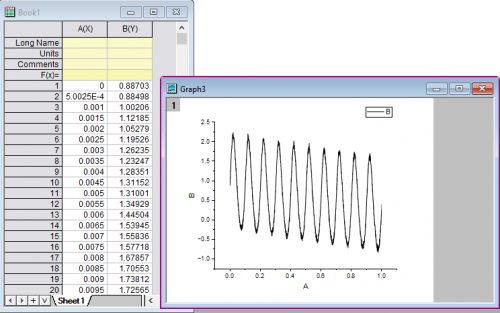
- Open a new project or a new workbook. Generate XY data with steps in section below. We will get a skewed, nonlinear near-bed wave
-
- Highlight column B, and then click the Empirical Mode Decomposition icon,
 , from Apps Gallery.
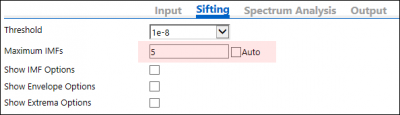
 - When the dialog is open, switch to Sifting tab, clear the checkbox of Maximum IMFs line, and then set this parameter to 5.
-
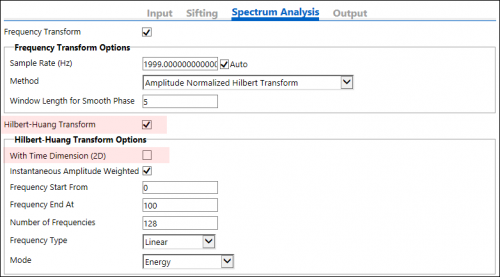
- Go to Spectrum Analysis tab, select the Hilbert-Huang Transform checkbox, and then under Hilbert-Huang Transform Options group, clear With Time Dimension (2D) checkbox.
-
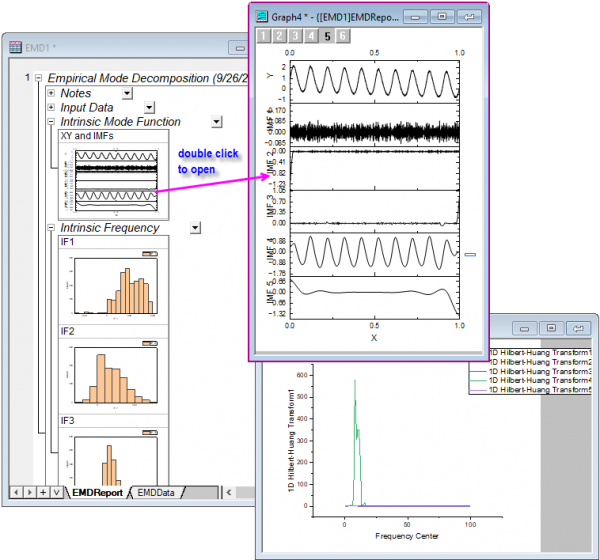
- Click Output tab, and change Output to New Book.
- Click OK.
-
Generating data of skewed, nonlinear near-bed wave
To simulate a non-linear waveform using equation 9 in [1].
![u(t)=U_wf\frac{\left [sin(\omega t)-\frac{r}{1+\sqrt{1-r^2}}\right ]}{[1-rsin(\omega t)]}](/app/en/images/Empirical_Mode_Decomposition/math-7334efdefebc77cdd2e82e7e04e3e449.png?v=0 "u(t)=U_wf\frac{\left [sin(\omega t)-\frac{r}{1+\sqrt{1-r^2}}\right ]}{[1-rsin(\omega t)]}")
|
(9) |
- Choose menu Window: Script Window to open Script Window if it is not yet open
- Copy and paste scripts below in Script Window, highlight all lines and press Enter to run them
range rx = [Book1]Sheet1!col(A);  // Column A range
range ry = [Book1]Sheet1!col(B);  // Column B range

sample_rate = 2000;  // Sampling frequency
seconds = 1;  // Number of seconds
num_samples = sample_rate * seconds;  // Number of samples
f = 10;  // Fundamental frequency
nonlin_deg = 0.25;  // Degree of non-linearity
nonlin_phi = -pi / 4;  // Skew in non-linearity

rx = data(0, seconds, seconds / (num_samples-1));  // Generate the time vector, and put it to column A

// The following is the equation 9 in [1]
factor = sqrt(1-nonlin_deg*nonlin_deg);
num = nonlin_deg * sin(nonlin_phi) / 1 + factor;
numerator = num + sin(2*pi*f*rx);
denominator = 1 - nonlin_deg * cos(2*pi*f*rx + nonlin_phi);
ry = factor * (numerator / denominator);

ry = ry  - sin(2*pi*0.1*rx);  // Add part of cycle as a trend
white_noise ry;  // Add some noise
[1] Abreu, T., Silva, P. A., Sancho, F., & Temperville, A. (2010). Analytical approximate wave form for asymmetric waves. Coastal Engineering, 57(7), 656–667. https://doi.org/10.1016/j.coastaleng.2010.02.005