Hinweis:Dieser Abschnitt ist nur in englischer Sprache verfügbar. Wir bitten um Ihr Verständnis.
2.42.1.1 The Power and Sample Size (DOE) Dialog Box
Contents
Supporting Information
To open the Power and Sample Size dialog
- Select Statistics: Quality Improvement: Design of Experiment from Origin menu
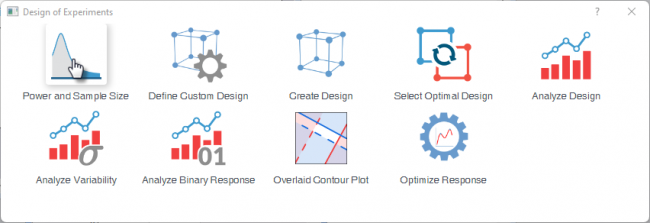
- Select the Power and Sample Size icon
 | Topics for Further Reading: |
Factorial Type
Select a factorial type from the list below.
- 2-Level Factorial
- Plackett-Burman
- General Full Factorial
Design
2-Level Factorial
| Number of Factors | The number of factors. Together with the fraction, this determines the base number of corner-point runs. |
|---|---|
| Fraction | The fraction of the full factorial to run. |
| Number of Blocks | Blocks group runs performed under homogeneous conditions. Default is 1 (unblocked design). |
| Number of Terms Omitted from Model | Terms deliberately left out of the fitted model; reducing model terms increases the available degrees of freedom for error and raises power. Default is 0. |
| Include Blocks in Model | When ON, block effects are estimated and removed from the error term, protecting the analysis if block-to-block variation exists. |
| Include Term for Center Points in Model | When ON, Origin fits a center-point (curvature) term, which slightly reduces power for factorial effects but allows a test for curvature. |
Plackett-Burman
| Number of Factors | The number of factors. |
|---|---|
| Number of Corner Points | The size of the Plackett-Burman design - must be a multiple of 4 and, as the note states, **no less than 12** (12 is the smallest standard Plackett-Burman design; the next sizes are 16, 20, 24, ...). |
| Number of Main Effect Terms Omitted from Model | Main effects deliberately excluded from the fitted model (default 0). Omitting terms frees degrees of freedom for error, which raises power |
| Include Term for Center Points in Model | When ON (as shown), Origin fits a center-point term so you can test for curvature across factors. |
General Full Factorial
| Number of Factors | The number of factors. |
|---|---|
| Number of Levels for Each Factor | One text box per factor - enter each factor's level count individually (e.g., 3, 2, 4 for a 3*2*4 design). The total base run count is the product of these values (3 * 2 * 4 = 24 runs before replication). |
| Model Order | The highest-order interaction included in the model: 1 = main effects only, 2 = main effects + two-factor interactions, 3 = up to three-factor interactions, and so on. |
| Block on Replicates and Include Blocks in Model | When ON, each replicate of the design is treated as a block, and block effects are estimated and removed from the error term. |
Settings
| Calculate | Select the quantity to compute:
|
|---|---|
| Replicates | Number of repetitions of the entire design. Disabled when it is the calculated quantity. |
| Effects | The minimum effect size to detect, in the response units of the measurement (can be a list of values). |
| Power | Desired power for detecting the specified effect(s); values between 0 and 1. Common targets: 0.8 to 0.9 (can be a list). |
| Number of Center Points per Block | Center-point runs added per block to estimate pure error and test for curvature. |
| Standard Deviation | The estimate of experimental noise (sigma), from historical data |
| Significance Level | Alpha - the risk of declaring an inactive effect significant. Default 0.05. |
Dialog Theme
Save and load the settings of the dialog.