2.42.1.1 The Power and Sample Size (DOE) Dialog Box
Contents
Supporting Information
To open the Power and Sample Size dialog
- Select Statistics: Quality Improvement: Design of Experiment from Origin menu
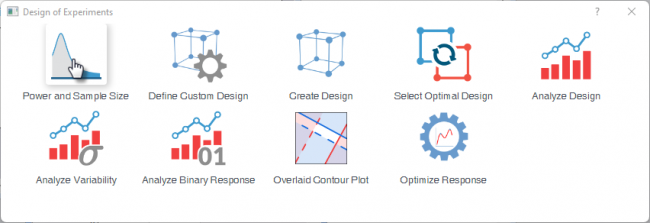
- Select the Power and Sample Size icon
 | Topics for Further Reading: |
Factorial Type
Select a factorial type from the list below.
- 2-Level Factorial
- Plackett-Burman
- General Full Factorial
Design
2-Level Factorial
| Number of Factors | The number of factors. Together with the fraction, this determines the base number of corner-point runs. |
|---|---|
| Fraction | The fraction of the full factorial to run. |
| Number of Blocks | Blocks group runs performed under homogeneous conditions. Default is 1 (unblocked design). |
| Number of Terms Omitted from Model | Terms deliberately left out of the fitted model; reducing model terms increases the available degrees of freedom for error and raises power. Default is 0. |
| Include Blocks in Model | When ON, block effects are estimated and removed from the error term, protecting the analysis if block-to-block variation exists. |
| Include Term for Center Points in Model | When ON, Origin fits a center-point (curvature) term, which slightly reduces power for factorial effects but allows a test for curvature. |
Plackett-Burman
| Number of Factors | The number of factors. |
|---|---|
| Number of Corner Points | The size of the Plackett-Burman design - must be a multiple of 4 and, as the note states, **no less than 12** (12 is the smallest standard Plackett-Burman design; the next sizes are 16, 20, 24, ...). |
| Number of Main Effect Terms Omitted from Model | Main effects deliberately excluded from the fitted model (default 0). Omitting terms frees degrees of freedom for error, which raises power |
| Include Term for Center Points in Model | When ON (as shown), Origin fits a center-point term so you can test for curvature across factors. |
General Full Factorial
| Number of Factors | The number of factors. |
|---|---|
| Number of Levels for Each Factor | One text box per factor - enter each factor's level count individually (e.g., 3, 2, 4 for a 3*2*4 design). The total base run count is the product of these values (3 * 2 * 4 = 24 runs before replication). |
| Model Order | The highest-order interaction included in the model: 1 = main effects only, 2 = main effects + two-factor interactions, 3 = up to three-factor interactions, and so on. |
| Block on Replicates and Include Blocks in Model | When ON, each replicate of the design is treated as a block, and block effects are estimated and removed from the error term. |
Settings
| Calculate | Select the quantity to compute:
|
|---|---|
| Replicates | Number of repetitions of the entire design. Disabled when it is the calculated quantity. |
| Effects | The minimum effect size to detect, in the response units of the measurement (can be a list of values). |
| Power | Desired power for detecting the specified effect(s); values between 0 and 1. Common targets: 0.8 to 0.9 (can be a list). |
| Number of Center Points per Block | Center-point runs added per block to estimate pure error and test for curvature. |
| Standard Deviation | The estimate of experimental noise (sigma), from historical data |
| Significance Level | Alpha - the risk of declaring an inactive effect significant. Default 0.05. |
Dialog Theme
Save and load the settings of the dialog.