2.42.3.2.2 Lack of Fit Test
Contents
Oeverview
The Lack of Fit test is used to determine whether the selected model adequately describes the relationship between the factors and the response.
The test separates the model error into two components:
- Lack of Fit
- Pure Error
The Lack of Fit Test compares these two sources of variation using an F-test:
\[ F = \frac{\text{Mean Square of Lack of Fit}}{\text{Mean Square of Pure Error}} \]
Supported design types
 | To perform lack of fit test, the design data should include replicates (multiple observations with identical predictor/x-values) |
To perform lack of fit Test
- Create the design with replicates or center points
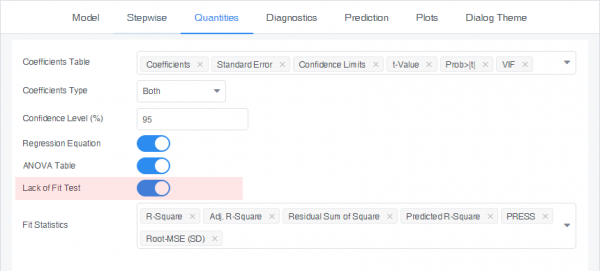
- In the Quantities tab of the analyze factorial design dialog box or analyze response surface design dialog box, make sure to select Lack of Fit test
-
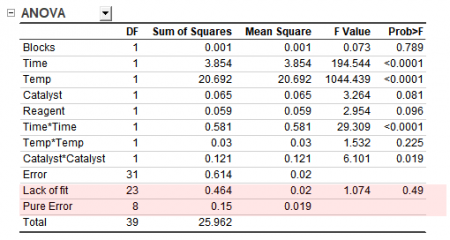
Results of Lack of Fit Test
The test results are in the ANOVA table of report sheet, which is u
Lack of Fit
Variation indicating that the model does not adequately capture the true relationship between the factors and the response
A small p-value indicates significant lack of fit
- P > 0.05: The model fits the data adequately
- P < 0.05: Indicates significant lack of fit, suggesting that the model may be inadequate and that a different model or additional terms may be needed.
Pure Error
Variation caused by random experimental error, estimated from replicated experimental runs.