2.43.2 Create Design


Introduction

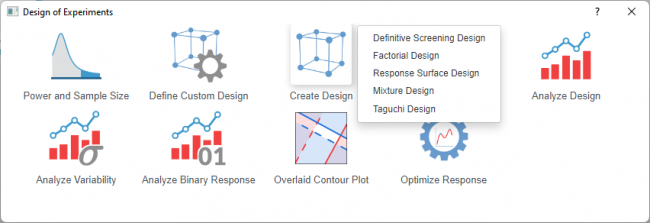
Use this feature to generate a new experimental design based on your study objectives and constraints. 5 design type is provided in Origin


Definitive Screening Design Factorial Design Response Surface Design Mixture Design Taguchi Design
Primary Purpose Screen many factors with minimal runs while detecting curvature Identify which factors significantly affect the response and estimate their interactions Model curvature and find optimal factor settings Optimize component proportions that must sum to 100% Make processes robust to noise (minimize variation)
Number of Factors 6+ factors (typically 6-20) 2-15 factors 2-6 factors (typically 3-5) 2-10 components 2-15+ control factors
Runs Required Minimal (2k + 1 for k factors) Moderate (2^k for full factorial, fewer for fractional) Moderate to high (depends on model complexity) Moderate (depends on model order and constraints) Moderate to high (depends on inner/outer array)
Can Detect Curvature Yes (quadratic effects estimable) No (unless center points added) Yes (primary purpose) Yes (can fit quadratic models) No (linear models only)
Can Estimate Interactions? Limited (two-factor interactions partially confounded) Yes (full factorial) or partially (fractional) Yes Special mixture terms, not standard interactions Limited (focus on main effects)
Factor Types Continuous Categorical or continuous Continuous (typically) Continuous components Categorical or continuous
Key Constraint None specific None specific None specific Components must sum to 1 (100%) Separates control and noise factors
Optimization Focus Screening + curvature detection Effect identification Finding optimal settings Optimal blend proportions Robustness to external variation
Typical Follow-up Response surface design on significant factors Full factorial or response surface design Confirmation runs None (often standalone) Confirmation runs

Processing

Topics covered in this section: