| Replica
|
Use these controls to fit your data to a built-in peak function by replicating the function for each peak, each of which may have different parameters. Your data should display multiple peaks of the same general form (e.g. Lorentzian or Gaussian) but with different centers or widths. If the function you have selected does not support replicas, this branch is disabled.
- Number of Replicas
- Specify the number of replicas. You must set the number to n-1, where n is the number of peaks you believe to be present in your data.
- Peak Finding Settings
- Settings related to peak finding.
- Peak Finding Method for Nonlinear Curve Fit
- Specifies the method to search peaks. Please see the Find Peaks page in the Peak Analyzer chapter for more details.
- Local Maximum
- Window Search
- 1st Derivative
- 2nd Derivative (search Hidden peaks)
- Residual after 1st Derivative (search Hidden peaks)
- Local Points(%)
- Only available when Local Maximum is selected in the Method drop-down list. Controls the number of points (local area) used for finding the peaks with the Local Maximum method.
- Window Height(%)
- Only available when Window Search is selected in the Method drop-down list. Controls the height of the rectangle used to find peaks. Edit the Height value in the text box.
- Window Width(%)
- Only available when Window Search is selected in the Method drop-down list. Controls the width of the rectangle used to find the peaks. Edit the Width value in the text box.
- Peak Finding Method for Nonlinear Surface Fit
- Specifies the method to search peaks.
- Local Maximum
- 1st Partial Derivative
- Contour Consolidation
- Local Points
- Controls the number of points in the X and Y directions (local area), used for finding peaks.
- Peak Direction
- Narrow the search for positive and/or negative peaks.
- Positive
- Find positive peaks only.
- Negative
- Find negative peaks only.
- Both
- Find both positive and negative peaks.
- Peak Min Height(%Y Scale)
- Control the minimum height of the found peaks. For Nonlinear Surface Fit, the label will read Peak Min Height(%Z Scale).
- Replicate From nth Parameter
- Specify which parameters to use for fitting multiple peaks. For example, in a Gaussian function, the parameters are ordered y0, xc, w, and A. If set to 2, Origin will start with the second parameter when replicating. The first parameter will have only one value, so y0 will remain common for all replicas. Similarly, z0 would be common for surface peak replicas.
- Number of Parameters Used in Replicas
- The number of parameters used in replicas.
- Plot Individual Peak Curve
- Available for Nonlinear Curve Fit. Specify whether or not to plot the fitted curve for each individual peak.
- Plot Cumulative Fitted Curve
- Plot the cumulative fitted curve. Becomes available when Plot Individual Peak Curve is checked for Nonlinear Curve Fit. It will be checked (and non-editable) for Nonlinear Surface Fit.
- See: Fitting Multiple Peaks with Replicas
|
| Fit Control
|
Use this tree to control the fitting process.
- Iterations
- Control of iteration properties during fitting.
- Max Number of Iterations
- Specify the max number of iterations performed when the Fit button is clicked. If the Tolerance condition cannot be satisfied after the given maximum number of iterations are performed, user may press Fit again. The same number of iterations will be performed. This option prevents the fitting operation from running too long if each iteration is very slow (when data is large or when there are many parameters).
- Tolerance
- Specify the tolerance in this box. Fitting will be viewed as complete if the reduced chi-square between two successive iterations is less than the tolerance value. The tolerance is calculated by:
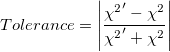
Where  is the chi-square value of current iteration, and is the chi-square value of current iteration, and  is the chi-square of the last iteration. Note that a small chi-square tolerance does not necessarily mean that the fit is good. If the parameter space is “flat” (a particular combination of large variation of parameters could cause only a change of the chi-square value. This is similar to over-parameterization), then one cannot say that the fit is good even if the chi-square tolerance is satisfied. is the chi-square of the last iteration. Note that a small chi-square tolerance does not necessarily mean that the fit is good. If the parameter space is “flat” (a particular combination of large variation of parameters could cause only a change of the chi-square value. This is similar to over-parameterization), then one cannot say that the fit is good even if the chi-square tolerance is satisfied.
- See also: Theory of Nonlinear Curve Fitting
- Derivative Delta
- This branch determines how the fitter computes the partial derivatives with respect to parameters for user-defined functions during the iterative procedure. This option is unavailable for built-in functions.
- Note: You can define a user-defined function with partial derivatives.
- For the user-defined functions, the derivative with respect to the parameter, p1, is computed as follows:
![derivative=[f(x,p_1+Delta,p_2,...)-f(x,p_1,p_2,...)]/Delta](/origin-help/en/images/Settings_Tab_Upper_Panel/math-42b21b7793a1dbdebadd712a2b878153.png?v=0 "derivative=[f(x,p_1+Delta,p_2,...)-f(x,p_1,p_2,...)]/Delta") where where  is the increment. is the increment.- Note: for simplicity, we suppose that the function has only one independent variable here.
- Delta
- The increment.
- Minimum
- Min value of the actual Delta. This text box is disabled when the Fixed check box is selected.
- Maximum
- Max value of the actual Delta. This text box is disabled when the Fixed check box is selected.
- Fixed
- Use fixed Delta value.
- If the Fixed check box is selected, the value entered in the Delta text box will be used as the delta values for all the parameters.
- If the Fixed check box is cleared, the actual value of Delta for a particular parameter will be equal to the product of the current value of the parameter and the value specified in the Delta text box. In this case, you can use the Maximum and Minimum text boxes to limit the actual Delta values in case a parameter value becomes too large or too small.
- Note: It is not recommended that you select the Fixed check box when you start fitting your new function.
- Parameters CI Computation Method
- Use this list to select the method to compute the parameters confidence intervals:
- Asymptotic-Symmetry based
- With the Asymptotic-Symmetry method, you will get asymptotic, symmetrical confidence intervals as calculated by a related equation.
- Model-Comparison based
- If the Model-Comparison method is used, the upper and lower confidence limits will be calculated by comparing the residual sum of squares.
- See: Theory of Nonlinear Curve Fitting.
- Scale Error with sqrt(Reduced Chi-Sqr)
- Available when fitting with weight. This check box only affects the error on the parameters reported from the fitting process, and does not affect the fitting process or the data in any way. It is enabled by default and the covariance matrix is calculated as:
 , otherwise, , otherwise,  . .
- When it is checked, it Scale Error with sqrt reduced Chi-Sqr to estimate error variance, and parameter's standard error is scaled by it, otherwise error variance is specified with 1, and parameter's standard error is not scaled.
- See also: Why parameter's standard error remains unchanged when error bar is scaled?
 | This option is checked by default to keep parameter's standard error and related results compatible with other software. It is recommended to uncheck this option when fitting data with instrumental weight, so that parameter's standard error can reflect the magnitude of weight.
|
- Invalid Weight Data Treatment
- If there is invalid value in weight data, Origin will throw an error.
- Replace with Custom Value
- Replace the Invalid Weight data with Custom Value
- Custom Weight
- Set the value of Custom Weight. This option is available when Replace with Custom Value is selected.
|
| Quantities
|
Control the quantities to be computed and displayed.
See: Theory of Nonlinear Curve Fitting
- Fit Parameters
- Use this branch to specify what is output to the Fit Parameters table of the report sheet.
- Meaning
- When this box is checked, a Meaning column is added to Parameters table in the result sheet (note that these will will be the same as those used in the Parameters table of the NLFit dialog). This box is unchecked by default.
- Unit
- The unit for parameters. If you checked this check box, a column "Unit" will be added into the Parameters table of the result sheet. The units defined in the Derived Parameter Settings box of the Fitting Function Organizer dialog will be shown in this column.
- Value
- The parameter values.
- Fixed
- Fix a parameter value.
- Standard Error
- The standard error of each parameter.
- LCL
- The lower confidence limit. The LCL results will be calculated for both parameters and derived parameters if there is any.
- UCL
- The upper confidence limit. The UCL results will be calculated for both parameters and derived parameters if there is any.
- Confidence level for Parameters (%)
- The confidence level for regression. This control is available only when either LCL or UCL is checked.
- t-Value
- The t-test value of parameters.
- Prob > |t|
- The p-value of parameters.
- Dependency
- The dependency values for parameters.
- Cl Half-Width
- The half-widths of the confidence intervals.
- Lower Bound
- Minimum parameter value.
- Upper Bound
- Maximum parameter value.
- Fit Statistics
- Control output to the Fit Statistics table of the report sheet.
- Number of Points
- The total number of input data points.
- Degrees of Freedom
- Model degrees of freedom.
- Reduced chi-Sqr
- The reduced chi square value.
- R Value
- The R value, equal to the square root of
 . .
- Residual Sum of Squares
- The residual sum of squares (RSS), or the sum of square error.
- R-Square (COD)
- The coefficient of determination.
- Adj. R-Square
- The adjusted coefficient of determination.
- Root MSE(SD)
- The residual standard deviation, or square root of mean square error.
- Number of Iterations
- The number of iterations required for the fit to run to completion.
- Fit Status
- Any fit status error code that is generated. You can see this Quick Help topic for details.
- Number of Replicas
- The number of replicas.
- Replicas From nth Parameter
- The index number of the starting parameter used to generate replicas.
- Number of Parameters Used in Replicas
- The number of parameters used to generate replicas.
- Fit Summary
- Control output of the fit summary table. When selected, options include Value, Standard Error, LCL, UCL, Adj.R-Square, R-Square(COD),Reduced Chi-Sqr.
- ANOVA
- Output the analysis of variance table.
- Covariance Matrix
- Output the covariance matrix.
- Correlation Matrix
- Output the correlation matrix.
|
| Residue Analysis
|
Options for output of residuals.
See: Graphic Residual Analysis
|
 See more related video:Selecting Data Range from Fitter

